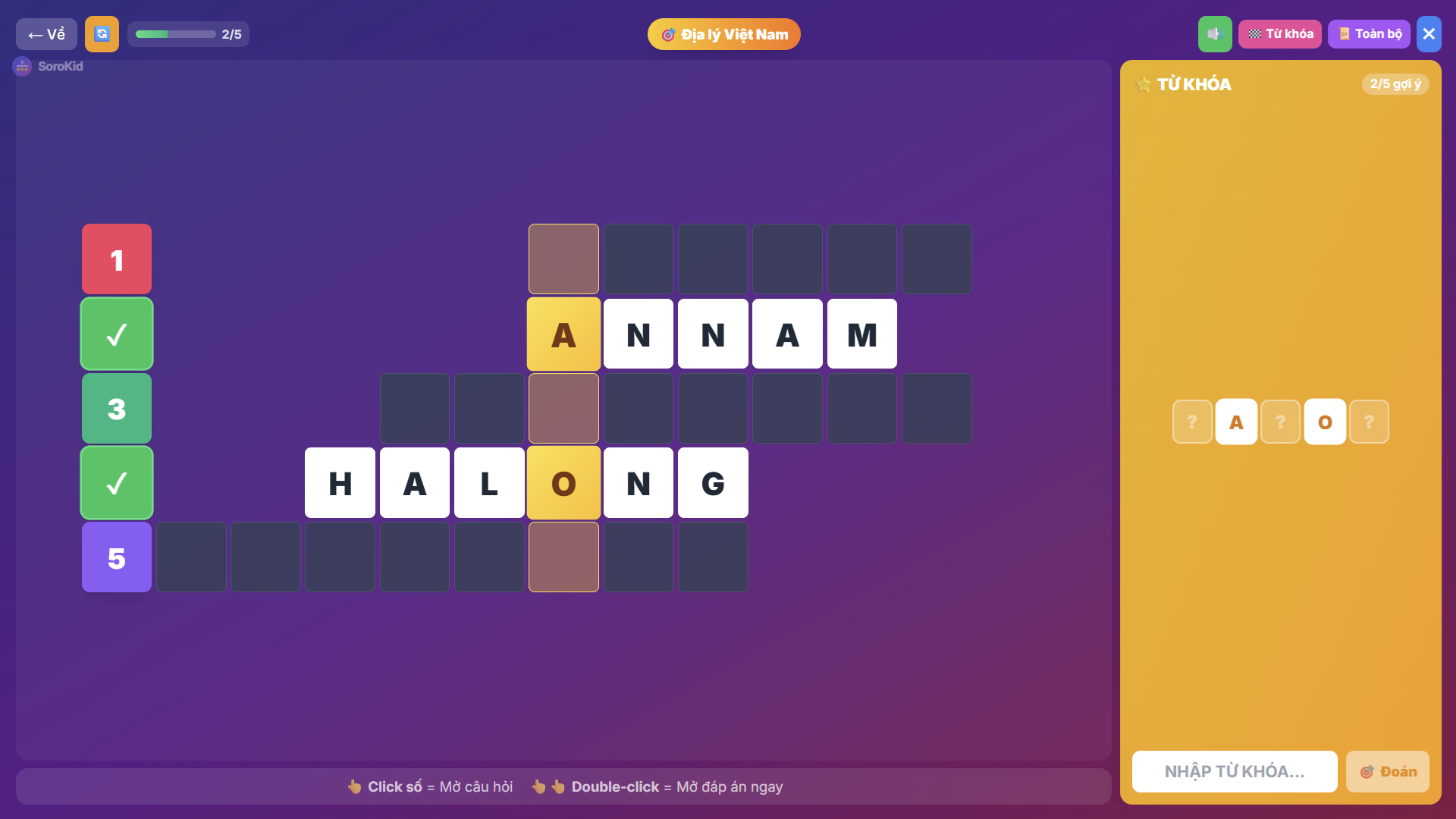
Crossword Puzzles in the Classroom: How I Made Vocabulary Review Fun Again
When vocabulary review used to mean 'read-copy-test,' my students dreaded it. Now they hunt for words like detectives, begging for 'just one more puzzle!' Here's how crossword puzzles transformed vocabulary retention and made review sessions the highlight of my week.
'Teacher! Number 5 across is BEAUTIFUL, right? The clue says adjective describing appearance and it has 9 letters!' The whole group cheered when they filled in the final word. That was vocabulary review for Unit 3 in my 7th-grade class. Before crossword puzzles, vocabulary review meant read-copy-test drudgery. Now students hunt words like detectives, so engaged they beg for 'just one more puzzle!' This is how crossword puzzles revolutionized vocabulary retention in my classroom.
What Makes Crossword Puzzles Educational Gold?
Crossword puzzles have been around for over a century, but their educational power is still underutilized. Here's why they work so well for vocabulary learning:
The Structure
- •Grid format: White and black squares create a visual challenge
- •Intersecting words: Across and down words share letters
- •Numbered clues: Each word has a hint that requires thinking
- •Letter constraints: Words must fit exact spaces
The Educational Benefits
- •Active recall: Students must retrieve words from memory, not recognize them
- •Contextual clues: Definitions are presented in new ways
- •Spelling practice: Every letter must be correct
- •Cross-checking: Intersecting words verify accuracy
- •Problem-solving: Multiple strategies required to complete
Research shows that active recall (retrieving information from memory) is far more effective for long-term retention than passive review (re-reading). Crossword puzzles force active recall in a game format.
My Vocabulary Review Before Crosswords
For years, my vocabulary review followed the same tired pattern:
- •Monday: Introduce new vocabulary words with definitions
- •Tuesday-Wednesday: Students copy words and definitions
- •Thursday: Practice sentences using vocabulary
- •Friday: Written vocabulary quiz
What I Observed
- •Students memorized definitions short-term, forgot by next week
- •Review sessions felt like punishment, not learning
- •Same students always struggled, same students always excelled
- •Boredom was visible—yawning, clock-watching, doodling
- •Quiz scores didn't reflect true understanding
I knew there had to be a better way. Vocabulary is fundamental to reading comprehension, writing ability, and academic success. Why was I making it so tedious?
Discovering Crosswords as a Teaching Tool
The idea came from an unexpected source—my grandmother's daily newspaper routine. She did crossword puzzles every morning, and at 82, her vocabulary was still razor-sharp. 'It's the best brain exercise,' she always said.
I wondered: What if I created crossword puzzles using our vocabulary words? The clues would be definitions, the answers would be vocabulary words, and students would have to actively retrieve and spell each word correctly.
First Attempt
I created a simple crossword with 10 vocabulary words from our current unit. The clues were paraphrased definitions—not copy-pasted from the textbook, but reworded to require actual understanding.
The result? Students who normally rushed through worksheets in 5 minutes spent 20 minutes on the puzzle. They were talking about the vocabulary—'Wait, what word means to make something better?' 'It starts with E because of the down word!' Collaboration. Engagement. Joy.
How I Create Effective Educational Crosswords
Choosing Words
- •Mix difficulty: Include some easy words for confidence, some challenging for growth
- •Focus on key vocabulary: 10-15 words per puzzle is ideal
- •Include review words: Mix current vocabulary with words from previous units
- •Consider letter patterns: Words with common letters (E, R, S, T) create more intersections
Writing Clues
- •Paraphrase definitions: Don't use exact textbook language
- •Include context clues: 'Verb meaning to improve (often skills or situations)'
- •Add letter counts: 'A beautiful sight (10 letters)' helps with verification
- •Vary clue types: Definitions, fill-in-the-blank, example sentences
| Clue Type | Example Vocabulary | Clue Example | Best For |
|---|---|---|---|
| Definition | BENEVOLENT | Showing kindness and generosity (10) | Most words |
| Fill-in-blank | INTEGRITY | A person with _____ always tells the truth (9) | Abstract concepts |
| Example | PERSEVERE | What marathon runners do when they want to quit (9) | Action words |
| Synonym | ENORMOUS | Giant, huge, massive (8) | Descriptive words |
| Antonym | COURAGEOUS | Opposite of cowardly (10) | Character traits |
Classroom Implementation Strategies
Individual Competition
Students work independently, first to complete wins a small prize. Works well for motivated classes and builds individual accountability.
Group Collaboration
Teams of 3-4 work together on one puzzle. Encourages discussion and peer teaching. Weaker students learn from stronger ones without feeling singled out.
Relay Race Format
Each team member solves one clue, then passes to the next person. Creates urgency and ensures everyone participates. My students' favorite format.
Self-Check Review
Students complete puzzles independently, then check against answer key. Lower pressure, good for homework or study guides.
Pro tip: Project the crossword on the board and solve collaboratively as a class. Call on students to suggest answers, but require them to explain why—'I think 3 across is PERSEVERANCE because the clue mentions never giving up and it has 12 letters.'
Results I've Seen
Measurable Improvements
- •Quiz scores: Average vocabulary quiz scores increased from 78% to 89%
- •Long-term retention: Students remember words from earlier units when they appear in crosswords
- •Spelling accuracy: Crosswords require exact spelling, so errors decreased
- •Writing quality: Students use more varied vocabulary in essays
Qualitative Changes
- •Engagement: Students ask 'When are we doing crosswords?' instead of dreading review
- •Discussion: Vocabulary conversations happen naturally during puzzles
- •Confidence: Struggling students celebrate small wins
- •Collaboration: Peer teaching increases without teacher prompting
Beyond Language Arts: Cross-Curricular Applications
Crosswords aren't just for vocabulary. I've shared this technique with colleagues across subjects:
Science
- •Scientific terminology (photosynthesis, mitochondria)
- •Chemical element names and symbols
- •Body parts and systems
- •Classification vocabulary
Math
- •Math vocabulary (quotient, numerator, variable)
- •Geometric terms (isosceles, perpendicular)
- •Written-out number answers
- •Word problem key terms
Social Studies
- •Historical vocabulary (revolution, democracy)
- •Geography terms (peninsula, archipelago)
- •Important names and places
- •Government and civics terminology
Foreign Language
- •Target language vocabulary with English clues
- •English clues with target language answers
- •Verb conjugations
- •Cultural vocabulary
Common Challenges and Solutions
Challenge: Some Students Finish Much Faster
Solution: Create extension puzzles with bonus words. Fast finishers can start the harder puzzle while others complete the first.
Challenge: Students Get Stuck and Frustrated
Solution: Allow 'hint cards'—each group gets 2-3 cards they can exchange for letter reveals. Creates strategy decisions about when to use limited resources.
Challenge: Creating Puzzles Takes Too Long
Solution: Use online crossword generators. Enter your words and clues, and the tool creates the grid automatically. Takes 10 minutes instead of an hour.
Challenge: Students Just Guess Letters
Solution: Require students to explain their answers verbally or write the word's meaning next to the puzzle. This ensures actual learning, not just pattern completion.
Student-Created Crosswords: The Ultimate Learning Activity
The most powerful vocabulary activity I've discovered is having students create their own crosswords.
Why It Works
- •Deep processing: Writing clues requires true understanding
- •Ownership: Students care more about words they've puzzled over
- •Peer teaching: Students solve each other's puzzles
- •Creative thinking: Transforms passive learning to active creation
Implementation
Each student creates a 10-word crossword using vocabulary from the unit. They write original clues, generate the puzzle, and create an answer key. Then students swap puzzles and solve each other's. The creator must verify accuracy.
When students create crosswords for peers, they think deeply about definitions, consider multiple meanings, and anticipate what clues will help or confuse. This metacognitive work is powerful learning.
Technology Integration
Digital vs. Paper
Both formats have merits:
| Factor | Paper Crosswords | Digital Crosswords |
|---|---|---|
| Accessibility | No tech needed | Requires devices |
| Immediate feedback | Only with answer key | Instant right/wrong indication |
| Collaboration | Easy to huddle around | Screen sharing needed |
| Tracking | Manual grading | Automatic completion tracking |
| Student preference | Some prefer tactile | Many prefer screen-based |
I use both: paper for group activities where students huddle together, digital for individual practice and homework where instant feedback helps.
The Bigger Picture
Crossword puzzles represent something larger: transforming necessary practice into something students want to do. The same vocabulary words that caused groans when presented as flash cards create excitement when presented as a puzzle.
The learning is the same—actually, it's better. But the experience is transformed. That's the power of gamification done right: not adding superficial rewards to boring activities, but redesigning activities to be inherently engaging.
Every teacher has content that students find tedious but essential. Crossword puzzles might not work for every subject, but the principle does: Find the game format that transforms your necessary practice into voluntary challenge. Your students will thank you—and their test scores will too.
Ready to make vocabulary review exciting? Try Sorokid Toolbox's free Crossword Generator—create educational puzzles in minutes with your own vocabulary words.
Create a Crossword