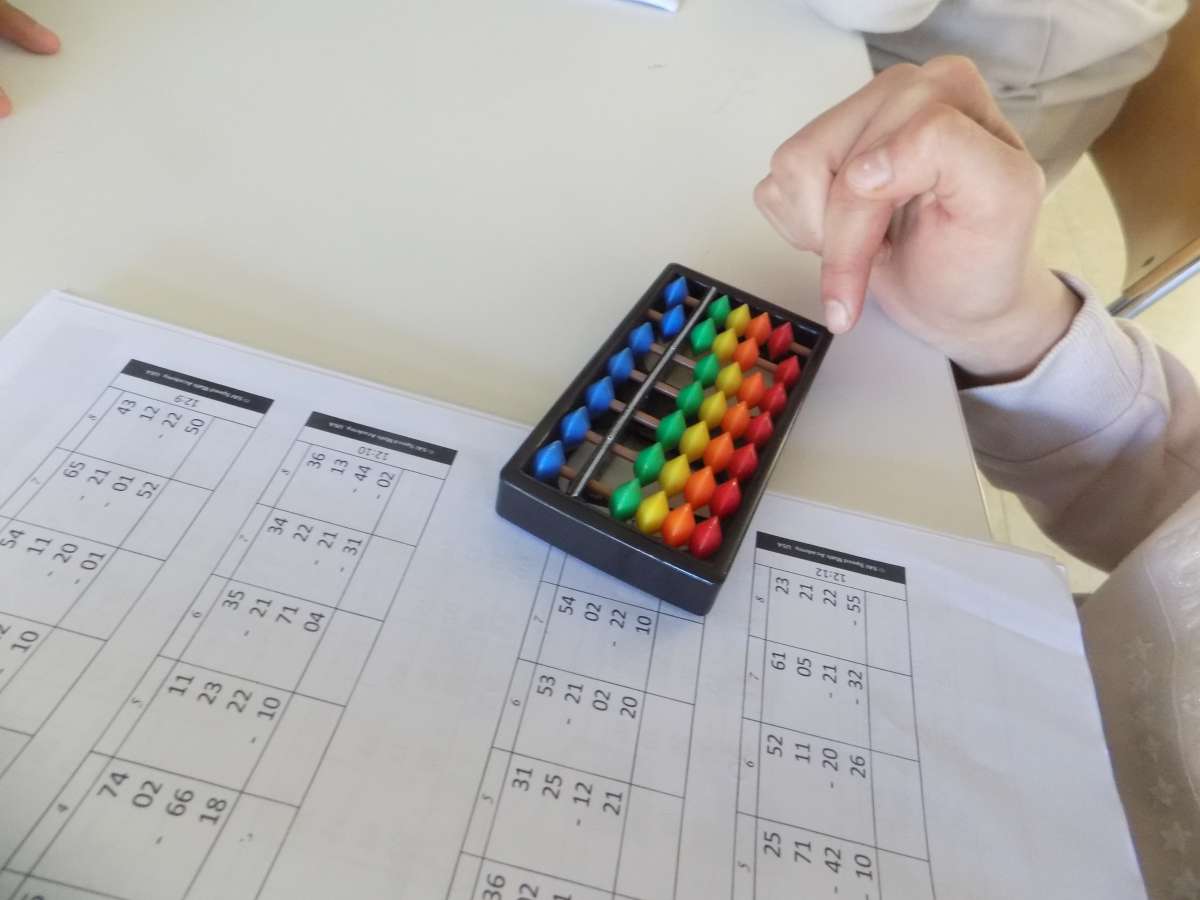
Subtraction with Borrowing on the Soroban: The Complete Parent's Guide to Teaching the 10-Complement Method
When my daughter hit 12-7 and couldn't figure out how to remove beads that weren't there, I knew we'd reached a pivotal moment. Here's how the soroban's elegant borrowing technique transformed her understanding of subtraction—and how you can guide your child through it.
There's a moment in every child's soroban journey that separates basic counting from real mathematical understanding. For my daughter, it happened with 12 minus 7. She looked at the ones column showing 2, looked at me, and said, 'Mom, I can't. There's only 2 there and I need to take away 7.' That moment of confusion was actually the doorway to something beautiful—the complement method that would transform not just her soroban skills, but her entire conception of how numbers work together.
Understanding the Fundamental Challenge
Before diving into technique, let's understand why borrowing exists and why the soroban handles it so elegantly. When we subtract 7 from 12 using pencil and paper, we cross out numbers, write little 1s, and perform a process that feels almost magical to children—but a magic they don't really understand.
The soroban makes borrowing visible and logical. You can see the tens become available, watch the exchange happen in real physical beads, and understand exactly why the answer is what it is. This visual, tactile experience creates understanding that abstract algorithms cannot.
The beauty of soroban borrowing: children see mathematics happening, not just follow arbitrary rules. When they understand why borrowing works, they can never be confused by it again.
The Core Concept: 10-Complements
Just as addition with carrying uses the concept of complements (pairs that add to 10), subtraction with borrowing uses the same complements in reverse. If you need to subtract 7 but don't have enough beads, you borrow 10 and add back the complement (3).
Think of it this way: subtracting 7 is the same as subtracting 10 and adding 3. The soroban makes this equivalence physical: remove a ten-bead, add three one-beads.
| Need to Subtract | Complement to Add | Why It Works |
|---|---|---|
| 1 | 9 | Taking 1 = Taking 10, giving back 9 |
| 2 | 8 | Taking 2 = Taking 10, giving back 8 |
| 3 | 7 | Taking 3 = Taking 10, giving back 7 |
| 4 | 6 | Taking 4 = Taking 10, giving back 6 |
| 5 | 5 | Taking 5 = Taking 10, giving back 5 |
| 6 | 4 | Taking 6 = Taking 10, giving back 4 |
| 7 | 3 | Taking 7 = Taking 10, giving back 3 |
| 8 | 2 | Taking 8 = Taking 10, giving back 2 |
| 9 | 1 | Taking 9 = Taking 10, giving back 1 |
Step-by-Step: Solving 12 - 7
Let's walk through the problem that stumped my daughter, with detailed explanation at each step.
Step 1: Set 12 on the Soroban
Place 1 bead up in the tens column (representing 10) and 2 beads up in the ones column (representing 2). The soroban now shows 12.
Step 2: Attempt to Subtract 7 from Ones
Look at the ones column. There are only 2 beads. We need to remove 7. Impossible with what's there. This is the borrowing signal.
Step 3: Identify the Complement of 7
The complement of 7 is 3 (because 7 + 3 = 10). Remember this number—we'll add it to the ones column.
Step 4: Borrow 10 (Remove 1 from Tens Column)
Push down the 1 bead in the tens column. The tens column is now empty. We've 'borrowed' 10.
Step 5: Add Complement to Ones
Add 3 (the complement) to the ones column. We had 2, now we have 2 + 3 = 5. Push up 3 more beads in the ones column.
Step 6: Read the Answer
The soroban now shows: tens column empty (0), ones column with 5 beads. Answer: 5.
The verbal pattern: 'Can't subtract 7 from 2. Complement of 7 is 3. Borrow 10, add 3. Two plus three equals five. Answer is 5.' Have your child say this aloud while doing the movements.
Another Example: 15 - 8
- •Set 15: 1 in tens, 5 in ones (using the upper bead for 5)
- •Attempt subtract 8: Can't—only 5 in ones column
- •Find complement: 8's complement is 2
- •Borrow 10: Remove the 1 from tens
- •Add complement: 5 + 2 = 7 in ones
- •Read answer: 7 ✓
Let's verify: 15 - 8 = 15 - 10 + 2 = 5 + 2 = 7. The math checks out, and your child can see exactly why.
A Third Example: 14 - 9
- •Set 14: 1 in tens, 4 in ones
- •Attempt subtract 9: Can't—only 4 in ones column
- •Find complement: 9's complement is 1
- •Borrow 10: Remove the 1 from tens
- •Add complement: 4 + 1 = 5 in ones
- •Read answer: 5 ✓
When Ones Column Gets Full During Borrowing
Sometimes adding the complement creates more than 5 in the ones column, requiring use of the upper bead. Example: 11 - 4.
- •Set 11: 1 in tens, 1 in ones
- •Attempt subtract 4: Can't—only 1 in ones
- •Find complement: 4's complement is 6
- •Borrow 10: Remove 1 from tens
- •Add 6 to 1: 1 + 6 = 7 (use upper bead + 2 lower beads)
- •Read answer: 7 ✓
Adding the complement sometimes requires its own technique if the ones column can't hold the sum directly. Practice simple complements first before tackling these compound situations.
Common Mistakes and How to Fix Them
Mistake 1: Forgetting to Remove from Tens
Children sometimes add the complement but forget to borrow (remove from tens). Result: answer too big by 10.
Fix: Establish a physical sequence. Left hand points to tens while saying 'borrow,' then right hand removes the bead. Only then does the right hand move to ones column. Make the tens-column action impossible to skip.
Mistake 2: Using Wrong Complement
If a child confuses complements (adds 4 instead of 3 when subtracting 7), answers will be consistently off by 1.
Fix: Drill complements separately until automatic. Flash cards, verbal quizzes, or games asking 'what plus 7 equals 10?' Build this foundation before complex borrowing problems.
Mistake 3: Trying to Subtract Directly When Possible
Sometimes children use borrowing even when unnecessary (like 15 - 3, which needs no borrowing). This wastes time and creates confusion.
Fix: Always check first: 'Can I subtract directly?' Only borrow when the answer is no. Make this checking step explicit and required.
| Symptom | Likely Cause | Solution |
|---|---|---|
| Answer 10 too high | Forgot to borrow (remove from tens) | Practice borrow-first sequence |
| Answer off by 1 | Wrong complement used | Drill complements separately |
| Unnecessary borrowing | Not checking if direct subtraction possible | Add explicit checking step |
| Frozen, can't proceed | Overwhelmed by steps | Break into smaller drills |
| Random errors | Complement memory shaky | More complement practice |
Building Automaticity: The Practice Progression
Phase 1: Complement Mastery (1-2 weeks)
Before any borrowing practice, ensure complements are instant. Quiz your child: '7's complement?' They should answer '3' immediately, without thinking. All nine complements must be automatic.
Phase 2: Slow Deliberate Practice (2-3 weeks)
Work through borrowing problems slowly, emphasizing the verbal script. Speed is irrelevant; correct process is everything. Use problems like 11-2, 12-3, 13-4 where complements are straightforward.
Phase 3: Mixed Practice (2-3 weeks)
Combine borrowing problems with non-borrowing problems randomly. The child must recognize which approach is needed. This builds the crucial 'check first' habit.
Phase 4: Speed Building (ongoing)
Only after accuracy is consistent, begin timing practice. Set achievable goals: 10 problems in 2 minutes, then gradually increase expectations. Never sacrifice accuracy for speed.
How Borrowing Relates to Addition Carrying
If your child has learned addition with carrying, borrowing is the mirror image. In carrying, when the ones column exceeds 9, we remove 10 from ones (using complement) and add 1 to tens. In borrowing, when the ones column can't provide enough, we remove 1 from tens and add 10 to ones (using complement).
These inverse operations use identical complements. A child who masters one finds the other easier to learn. Practice them together to reinforce the underlying relationship.
Carrying and borrowing are two sides of the same coin. The complement that helps you 'carry over 10' in addition is the same complement that helps you 'borrow 10' in subtraction. Understanding this duality deepens mathematical comprehension.
Multi-Column Borrowing (Advanced)
Eventually, problems like 102 - 35 require borrowing across multiple columns. The same principle applies repeatedly: when you can't subtract in one column, borrow from the next higher column.
If the next column is also empty (like borrowing for 102 - 35, where the tens column is 0), you must first borrow from hundreds to fill tens, then borrow from tens to handle ones. This chaining is complex but follows the same fundamental logic.
Don't rush to multi-column borrowing. Master single borrowing thoroughly first. Premature advancement creates confusion and erodes confidence.
Practice Problems for Your Child
Level 1: Basic Borrowing
- •11 - 2 = 9 (complement of 2 is 8, so 1 + 8 = 9)
- •11 - 3 = 8 (complement of 3 is 7, so 1 + 7 = 8)
- •11 - 4 = 7 (complement of 4 is 6, so 1 + 6 = 7)
- •12 - 5 = 7 (complement of 5 is 5, so 2 + 5 = 7)
- •13 - 6 = 7 (complement of 6 is 4, so 3 + 4 = 7)
Level 2: Varied Numbers
- •14 - 7 = 7
- •15 - 9 = 6
- •16 - 8 = 8
- •17 - 9 = 8
- •13 - 8 = 5
Level 3: Mixed (Some Need Borrowing, Some Don't)
- •15 - 3 = 12 (no borrowing needed)
- •15 - 8 = 7 (borrowing needed)
- •18 - 5 = 13 (no borrowing needed)
- •18 - 9 = 9 (borrowing needed)
- •14 - 4 = 10 (no borrowing needed)
FAQ: Common Parent Questions About Borrowing
Is soroban borrowing the same as school borrowing?
Mathematically yes, visually no. School algorithms use crossing out and rewriting. Soroban shows the same exchange physically. Children who understand soroban borrowing often find school algorithms suddenly make sense—they see what those abstract symbols represent.
What if there's nothing in the tens column to borrow?
Borrow from the next higher column (hundreds) first. If hundreds is also empty, go to thousands. The principle chains indefinitely. For beginners, stick to problems where tens column has something to borrow.
Should my child practice carrying and borrowing together?
Yes, once both are individually understood. They reinforce each other since they're inverse operations using the same complements. Mixing them builds deeper number sense and prevents confusion about when to use which technique.
Ready to master soroban subtraction? Sorokid's step-by-step lessons guide your child through borrowing with visual demonstrations and adaptive practice.
Start Learning Borrowing